
Fight on toward goals that keep receding, or exit with most objectives unmet. Trump is agitated, his poll numbers falling below the Plimsoll line, his base fractured between those who back the war and those who remember that he campaigned on ending them.

Chief of Defence Staff Gen Anil Chauhan identifies China border dispute as India's biggest national security challenge, followed by Pakistan's proxy war. He also highlighted regional instability, future warfare scenarios, and dealing with nuclear-armed adversaries as major concerns.

India and the US have collaborated through the past one month on launching a powerful satellite; are commencing joint production of GE Aerospace's F414 jet engines in India; India is participating in a massive three week-long military exercise in the Western Pacific, observes Ambassador M K Bhadrakumar.
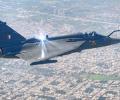
India's military expenditure in 2024 was nearly nine times that of Pakistan's, according to a study released by the Stockholm International Peace Research Institute (SIPRI). India's spending reached USD 86.1 billion, while Pakistan spent USD 10.2 billion. China's military spending continued to rise, reaching USD 314 billion, accounting for 50% of all spending in Asia and Oceania.

The United States, Russia, United Kingdom, France, China, India, Pakistan, Israel and North Korea possess approximately 16,300 nuclear weapons collectively. A glimpse of nine countries with nuclear weapons.
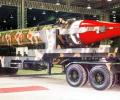
According to the report, Russia tops the table with 6,375 warheads, followed by the United States with 5,800, and the United Kingdom with 215 warheads.

China displayed a range of new weapons at a military parade, including laser weapons, nuclear ballistic missiles, giant underwater drones, and fifth-generation aircraft.
There's a necessity for talks between India and Pakistan, insulated from the political climate, to reduce the danger of growing nuclear arsenals and introduce transparency to prevent an arms race, said a statement adopted at the third Ottawa Dialogue held in Copenhagen on June 18 and 19.
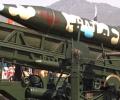
'The Indian gung-ho leadership may like to think about it, there should never ever be a doubt in anyone's mind, friend or foe, that Pakistan's operationally ready nuclear capability enables every Pakistani leader the liberty, the dignity and the courage to look straight into the Indian eye and never blink.'

Congressional report estimated Pakistan's nuclear warheads to be between 110-130.

In the wake of the recent hostilities, both sides have moved from weapons to words, with India dispatching several delegations to visit more than 30 capitals across the world. A similar effort by Pakistan is set to start on Jun 2.

Top military officials from India and Pakistan highlighted their views at the Shangri-La Dialogue in Singapore, billed as Asia's premier defence forum, amid heightened tensions between the two sides following last month's military confrontation.
Pakistan is believed to have 140-150 nuclear warheads this year, 10 more than last year. In contrast, India is said to have 130-140 nuclear warheads, according to the annual nuclear forces data by Stockholm International Peace Research Institute.

The nine nuclear-armed states -- the United States, Russia, the United Kingdom, France, China, India, Pakistan, Israel and the Democratic People's Republic of Korea (North Korea) -- together possessed an estimated 13,080 nuclear weapons at the start of 2021.
"We estimate that Pakistan now has a nuclear weapons stockpile of 130-140 warheads. This stockpile exceeds the projection made by the US Defense Intelligence Agency in 1999 that Pakistan by 2020 would have 60-80 warheads," said the report released last month.
Pakistan on Monday successfully test fired the nuclear-capable Babur cruise missile with a range of 700 km that could hit targets deep inside India, with the military saying the launch had consolidated and strengthened the country's deterrence capability.

A leading US daily describing nuclear-armed Pakistan as "unquestionably the biggest concern" to stability in South Asia.

India had enough weapons-grade plutonium by 2014 to possess an estimated arsenal of 75 to 125 nuclear weapons, according to a prominent US-based think-tank.
Pakistan's maneuvers will force both sides, at tremendous cost, to upgrade their state of strategic readiness in the early stages of conflict or military standoff, creating a dangerous escalatory scenario, according to Brigadier (Retired) Arun Sahgal and Rahul Bedi
Instead of trying to benefit from India's economic growth, Pakistan is expected to continue with its anti-India narrative by not only continuing to build up its nuclear arsenal, but also support terrorist outfits as proxies, American lawmakers have been told.
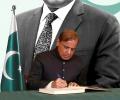
Pakistan has announced the creation of a new Army Rocket Force equipped with advanced technology to strengthen its combat capabilities. The announcement was made by Prime Minister Shehbaz Sharif, who also commented on the recent military confrontation with India and expressed gratitude to various countries for their support.
"Pakistan's jump from an estimated 60 to 110 nuclear weapons is unlikely to shift the balance of power vis a vis India," said Alexander H Rothman and Lawrence J Korb from the Centre for American Progress in their analysis of the recent news reports that Pakistan's nuclear arsenal.
"We estimate that Pakistan now has a nuclear weapons stockpile of approximately 170 warheads. The US Defense Intelligence Agency projected in 1999 that Pakistan would have 60 to 80 warheads by 2020, but several new weapon systems have been fielded and developed since then, which leads us to a higher estimate," the Nuclear Notebook column published in the Bulletin of the Atomic Scientists on September 11 said.
Referring to Pakistan's NSG membership application, the CRS said according to US law, the Obama Administration could apparently back Islamabad's NSG membership without Congressional approval.
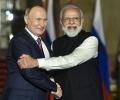
Notably, India has been calling for dialogue and diplomacy since the war began between Russia and Ukraine.
For the world and India, one of the most enduring challenges of the times is for Pakistan's nukes to be neutralised, before they are ever used by the State, their sponsored non-State actors or any rogue elements from the many terror tanzeems dotting Pakistan's unstable landscape, says Lieutenant General Kamal Davar (retd).

The US assessment of nuclear weapons security in Pakistan appears to have changed considerably from confidence to concern, particularly as a result of the introduction of tactical nuclear weapons, the report said.

'In this regard, the future stability of Pakistan remains a wild card,' said the report.

'India must close the missile technology gap with both China and Pakistan as early as possible, or else the credibility of India's nuclear deterrence will remain suspect,' says Brigadier Gurmeet Kanwal (retd).
India on Friday voiced concern over the 'danger and threat' of Pakistan's nuclear arsenal falling into the hands of terrorists and said it is closely monitoring the situation in the neighbourhood.
Officials are stressing that the civilian nuclear deal is only one part of the US-India cooperation and the success of a Presidential visit ought not to be pegged on this one aspect.
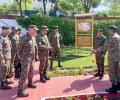
'India today feels enough is enough and we need to teach Pakistan a lesson.' 'Unless compelled, Mr Modi will think 10 times before taking the extreme step.'

Dhanteras, the prime minister said, has become even more special.

Indian policymakers must incorporate in their nuclear doctrine a realistic response to tactical nuclear warheads, says Ajai Shukla.

India's tactical and operational response demonstrated its ability to prosecute tri-service operations, even without a formal tri-service doctrine or the higher command structure needed to coordinate it, points out Ajai Shukla.
Estimated to have more nuclear weapons than India, Pakistan is rapidly developing and expanding its atomic arsenal, spending about $2.5 billion a year to develop such weapons, a report has said.

'This was undoubtedly a premeditated strategy to thwart India's entry into the NSG.' 'If India hopes to be a major player, it must use its rising clout on the world stage to influence amenable members of the group to alter such discriminatory practices and ensure fair rules of engagement,' says Vivek Gumaste.

Unless Donald Trump takes a major U turn, this is possibly the beginning of the end for Trumpian politics, argues Colonel Anil A Athale (retd). Unless President Trump takes a major U turn, this is possibly the 'beginning of the end' for Trumpian politics driven by TV trp's, points out Colonel Anil A Athale (retd).
India on Wednesday said the terror attack on a naval base in Karachi was a cause of serious concern, particularly with regards to the safety of nuclear arsenal in Pakistan, but it does not want to overreact.
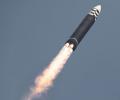
This is the first time in decades that China has made its flight test of an intercontinental ballistic missile public in an apparent show of strategic deterrence, State-run China Daily reported.
